Local mode
The local mode runs a workflow on this machine, without a cluster, a registry or a mounted store. It is the same service, planner, harness, records and web app as on the cluster, with a backend which runs the tasks as processes. The time of a run is the time of its processes plus a fraction of a second per task.
pip install simrun
simrun submit fit.yaml --source model=. --local
simrun outputs <run> <task> --to results
The switch
--local on a command makes it talk to the local service of the current directory instead of SIMRUN_URL; no environment variable is needed. It is accepted by submit, estimate, wait, status, list, logs, outputs, cancel, compare, cleanup, usage and edit. Without --local the same command runs on the cluster, see Command line.
submit --local waits for the run by default and prints a live line per task on a terminal and plain lines otherwise; it exits like wait (0 if the run succeeded, 1 if it failed or was cancelled, 2 on --timeout). --no-wait returns at once with the run, as on the cluster.
The service of a project
The local service keeps everything in .simrun/ of the current directory, like .venv: store/ (runs/, snapshots/), scratch/, envs/ (the environments of the runs with --snapshot), the index simrun.sqlite, the generated tokens tokens.yaml, service.json, service.log and a .gitignore of everything, so none of it lands in git. It listens on 127.0.0.1 on a free port only.
A --local command starts the service in the background when none runs, waits for its service.json and uses it. The service exits after 30 minutes without a request and without a live run, and a stopped service is started again by the next command. The service runs the python, the simrun and the task types of the command which started it; service.json records them, and a command whose environment differs (another venv, a new or upgraded plugin, another simrun) restarts a service in the background which has no live run and no open request, else it warns and uses the running one. simrun serve --local --stop stops the service of the directory (its runs are cancelled) and waits for its end.
simrun serve --local runs the service in the foreground instead and prints its address; Ctrl-C, SIGTERM or SIGHUP cancels the runs and waits for their processes (up to 60 s, printing what it waits for), so no process of a run outlives a graceful stop. A service killed without its cleanup (SIGKILL, the out of memory killer) leaves the processes of its runs running; the next service of the directory kills them when it starts. One service runs per directory. See serve for the file service.json and the check of the instance before the token is sent.
The web app
The service serves the web app at /ui/: the Executions with live updates, and the Editor (simrun edit --local). The wheel ships the built app (simrun/web); a checkout serves frontend/dist once it is built, see Development. The app asks for a token: the one in .simrun/service.json. The server strip shows this machine as the one server.
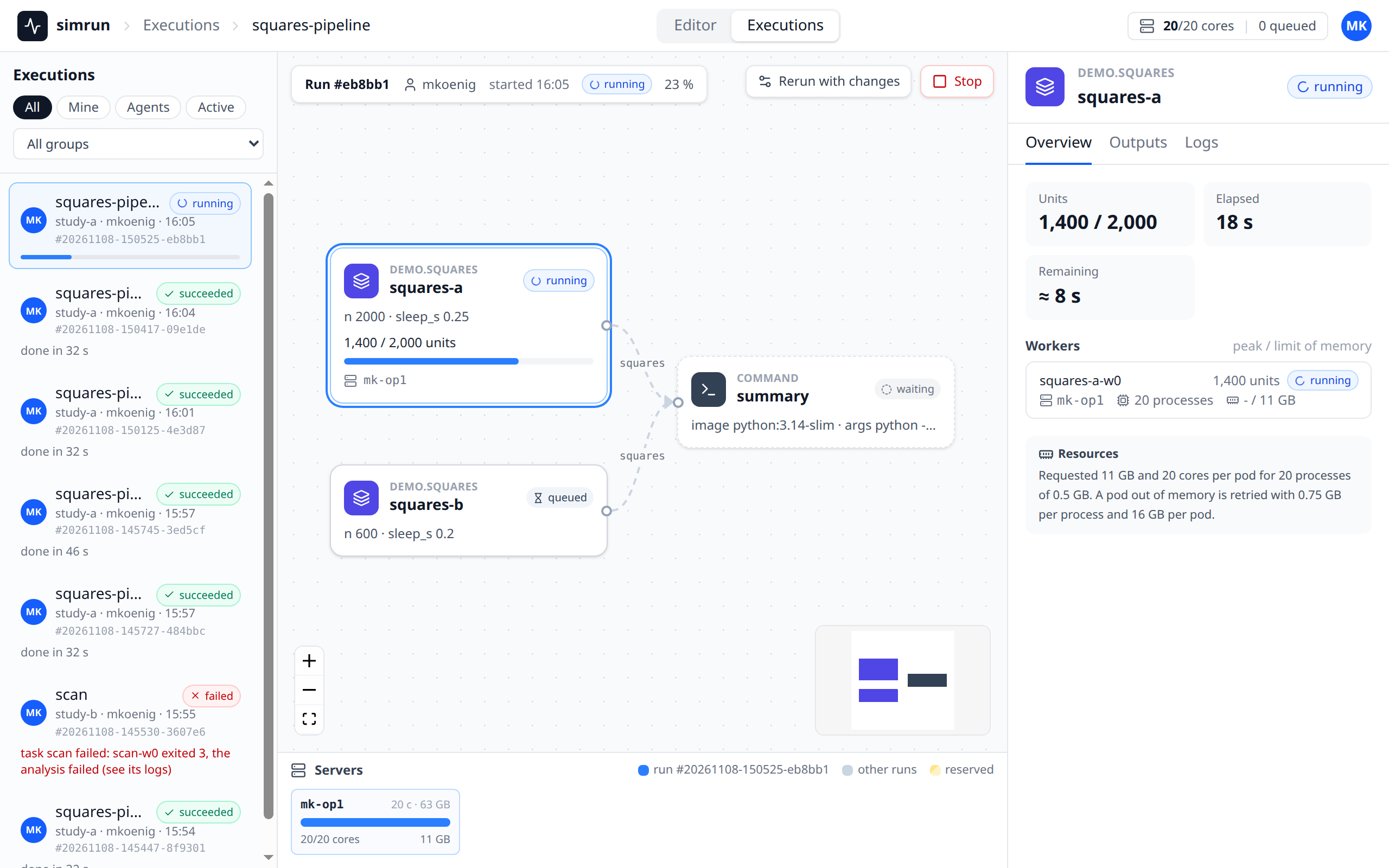
How tasks run
The LocalBackend of the service runs the pods of a run as processes of this machine:
- a split task is one coordinator process (
simrun-worker) with as many processes as the machine has cores, which computes the units and merges them itself; there are no extra workers, and the plan (also ofestimate --local) has one pod - a task of a plugin type runs through
simrun-exec, without an image: in the environment of the service, activated (its python first onPATH), and with the working tree of the model first onPYTHONPATH, aspython -min the checkout - a
commandtask runs its args directly by default, or in its image withdocker runwhen the run is submitted with--docker; the run records which. The store and the scratch directory are mounted at the same paths - a task starts when the tasks it reads from succeeded and its cores are free; the cores are shared by all runs of the service, in the order of submission, and a waiting task is
queued - a process stopped from outside (no exit code, 137 or 143) is retried as on the cluster, after a kill (137) with the retry memory per process, so the harness runs fewer processes; there is no memory limit per task, a process which takes too much is killed by the out of memory killer of the machine
The backend sets SIMRUN_CORES (the cores of the worker), SIMRUN_MEMORY_LIMIT_GB (its memory, by which the harness sizes its pool of processes; nothing kills a process above it) and SIMRUN_MEMORY_SOURCE=process in the environment of a process: the processes share the cgroup of the machine or of the session, so the harness measures the memory of its own process tree in /proc instead of the one of the cgroup, and learns the resources of a task from it as on the cluster. The scratch directories are in .simrun/scratch/, the logs of every process are in .simrun/store/runs/<run>/tasks/<task>/logs/, and simrun logs reads them as it does on the cluster.
Sources
Locally the sources are recorded, not copied: the provenance (branch, commit, uncommitted files, the hash of the diff) is stored as on the cluster, and the processes run with the python environment of the command, so the code is the working tree as installed in it, e.g. editable. Nothing is snapshotted or installed, which keeps a run as fast as running the code by hand.
--snapshot on submit and edit copies the working trees into snapshots/, when a run must not see later changes of the tree. The run gets an environment of its own, a venv in .simrun/envs/<run>/ which sees the packages of the command's python, and the snapshots are installed into it as editable packages without their dependencies, never into the environment of the command; the harness runs with its python, and a command task finds it first on PATH. The installer is uv (else pip), which builds the snapshots with their build backends from the index or its cache. The venv is removed at the end of the run.
What differs from the cluster
| cluster | local | |
|---|---|---|
| the machines | the servers of the cluster | this machine |
| priorities and preemption | Kueue, six priority classes | none, the tasks run in the order of submission |
| reservations of nodes | yes | refused |
| images | built with BuildKit per environment | none; a command may use its image with --docker |
| sources | snapshots, installed in the image | provenance only, unless --snapshot: installed in a venv of the run |
| store | shared drive, or uploads through the API | .simrun/store/ |
| extra workers of a split task | spread over idle servers | none, one worker with all cores |
The records, logs and outputs have the layout of a cluster run, see Concepts.