Open Science Workshop
Overview
Introduction & Motivation
Reproducibility is a cornerstone of modern computational research — yet many everyday workflows in data science, systems biology, and computational modeling remain fragile, siloed, or dependent on personal conventions. Researchers frequently encounter challenges such as:
- inconsistent Python environments
- missing metadata or unclear provenance
- scattered reference collections
- non-reproducible documents or analysis pipelines
- difficulty sharing results in open and citable formats
This workshop addresses these challenges by providing a practical, hands-on introduction to tools that make computational research open, transparent, and verifiably reproducible.
The workshop is made possible through support from the Open Science Ambassador Program at the Berlin University Alliance (BUA), which aims to empower researchers to adopt open, FAIR, and reproducible practices across all phases of the research lifecycle.
All workshop material is available from https://github.com/matthiaskoenig/open-science-workshop.
🎯 Workshop Goals
By the end of the day, participants will:
- understand core principles of open science and reproducible workflows
- learn to manage Python environments reliably using uv
- create citable research assets using Zenodo
- organize and maintain structured reference libraries with Zotero
- produce professional, reproducible documents using Typst
- publish integrated analyses and reports using Quarto
- reflect on their own workflow practices through LEGO® Serious Play
- gain confidence to integrate open tools into their daily research
🧰 Tools Covered in the Course
The course does not have to be done linearly—you can explore the content in any order. Choose the learning path that best suits your goals, interests, or current knowledge level. This way, you stay engaged and make the most of your learning experience.
- uv — Reliable Python Environment Management (?sec-uv) A fast, modern tool for Python environments and package management, enabling reproducible computational modelling across machines and teams.
- Zenodo — Citable Research Outputs (?sec-zenodo) A platform for sharing datasets, code, models, and workflows with persistent DOIs. Essential for transparency, credit, and long-term accessibility.
- Zotero — Reference & Knowledge Management (?sec-zotero) Open-source reference management for organizing literature, annotations, and citations across projects.
- Typst — Modern Document Preparation (?sec-typst) A next-generation typesetting system designed for scientific writing: fast, reproducible, expressive, and accessible.
- Quarto — Reproducible Publishing (?sec-quarto) A unified toolchain for scientific and technical publishing, enabling dynamic reports, manuscripts, slides, and websites.
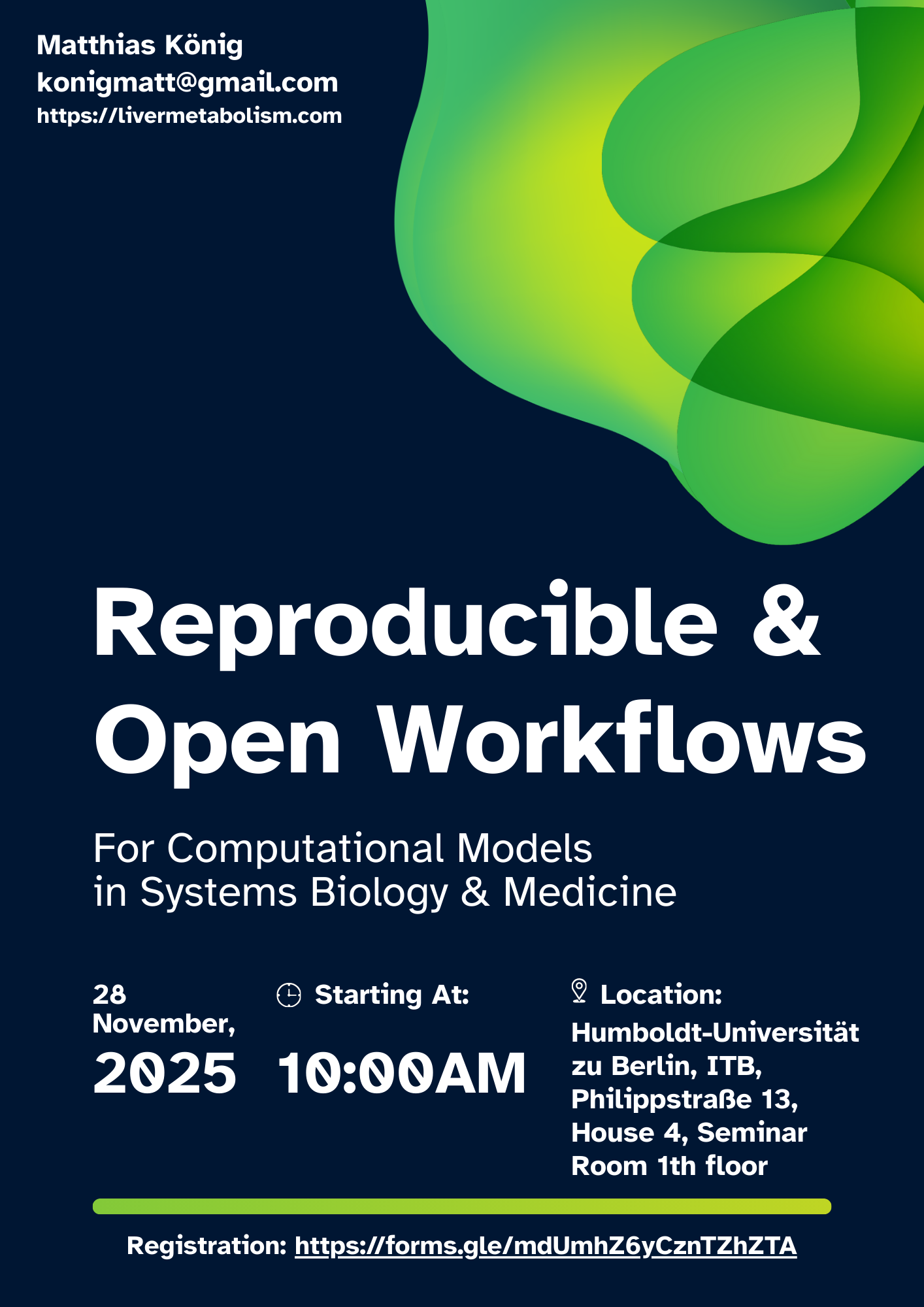
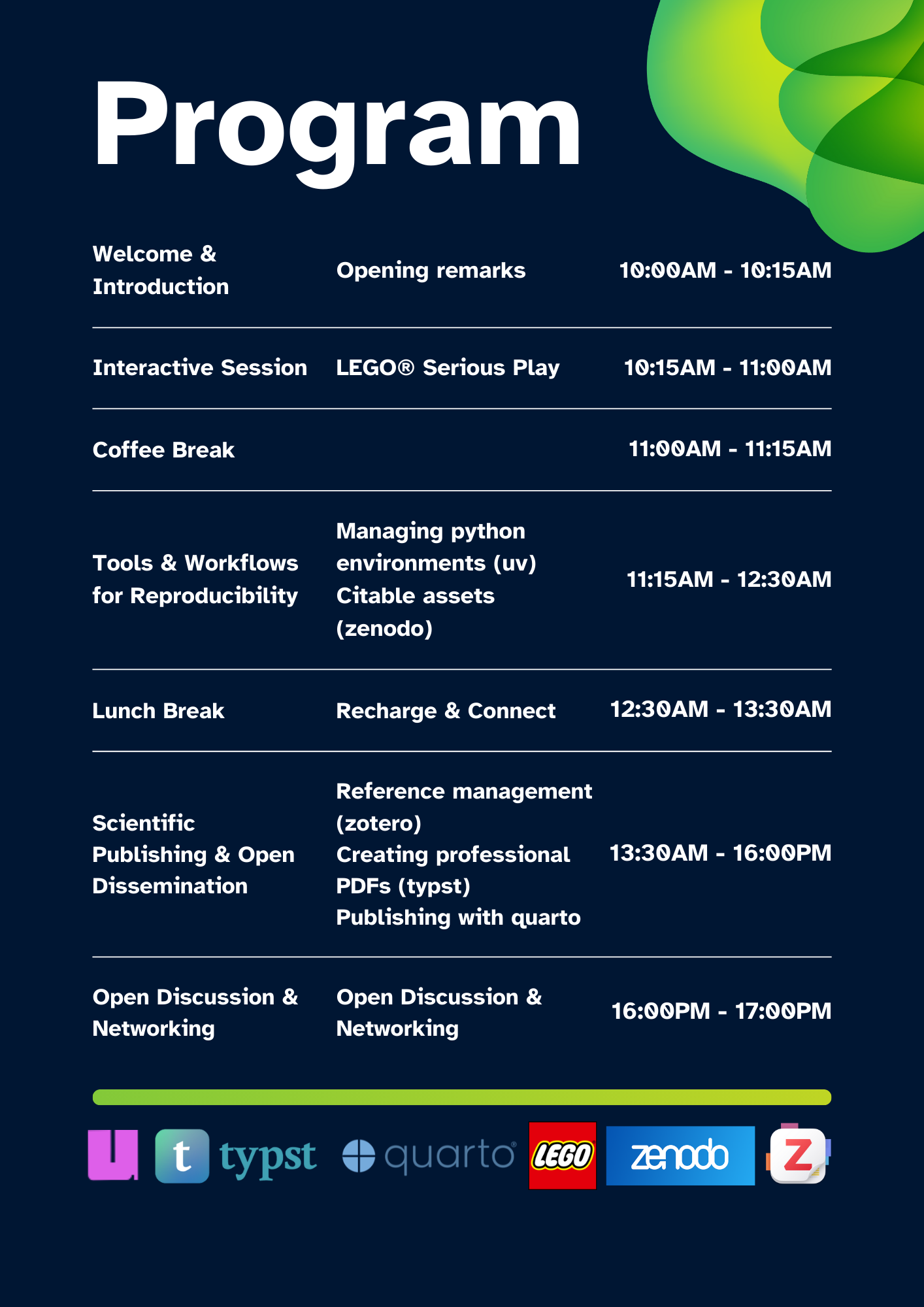
The program is shown in ?fig-flyer1 and ?fig-flyer2.
Program
Reproducible & Open Workflows for Computational Models
Humboldt-Universität zu Berlin — 28 November 2025, 10:00–17:00
Funded by the BUA Open Science Ambassador Program
This course is a work in progress, and we’re always looking for ways to make it better. If you have suggestions, ideas, or feedback on what to improve or how to enhance your learning experience, please don’t hesitate to get in touch. Your input is valuable and appreciated!