Figures
The figures of a model are generated from its definition, never drawn by hand: the anatomical figure of the male and the female build, the schematic of the circulation, the one-page figure of a publication which combines both, an interactive page and an interactive snippet of each for the web, and the bodies of individuals of the library. They read the definition through the same rules as the build (parts_for, luminal_substances, bile_substances, the absorption of the intestine variant), so a figure shows what the model has. Every figure is SVG, pure python and deterministic: the same definition gives the same bytes.
The figures on this page are those of the glimepiride-like model of the tutorial, given orally and intravenously; scripts/visual/docs_figures.py writes them and tests/docs/test_docs_figures.py fails while one is out of date. The docs show the anatomical figure (A) and the schematic (B) as interactive pages only, and every page of the PBPK library which creates a model shows its two figures after the fence which creates it: the script runs the fences of the page up to the definition, writes its figures into img/figures/models/ and the frames which show them into a generated region of the page (<!-- generated: figures-<page>-<snippet> ... -->). A frame takes the height its page posts (docs/javascripts/figures.js).
| Figure | Function | Written by create_archive |
|---|---|---|
| Anatomical figure | anatomy_figure(definition, path) |
<sid>_body.svg (key <sid>_body_svg) |
| Readouts of the anatomical figure | write_readouts(content, path) of pkpdsim.pbpk.visual.interactive |
<sid>_body.readouts.json (key <sid>_body.readouts_json) |
| Bodies without annotations | anatomy_figure(definition, path, annotations=False) |
no |
| Schematic | model_figure(definition, path) |
<sid>.svg (key <sid>_svg) |
| Interactive page | interactive_figure(definition, path, figure="anatomy" or "schematic") |
no |
| Interactive snippet | interactive_figure(definition, path, figure=..., snippet=True) |
<sid>.html, <sid>_body.html |
| Publication figure | publication_figure(definition, path, pdf=False) |
no |
| Bodies of individuals | body_strip(individuals) of pkpdsim.pbpk.visual.body |
no |
An interactive figure comes in two forms. interactive_figure(definition, path) writes a whole page, which a page of the docs embeds in a frame (the page posts its height, docs/javascripts/figures.js), and interactive_figure(definition, path, snippet=True) writes a snippet, one <div> which a page of markdown or HTML embeds as it is: the style sheet of the snippet, the style sheet and the ids of its SVG and its script are scoped to that <div> (its id is pkf-<sid>-<figure>), so the two snippets of a model stand on one page without touching it or each other, and the snippet brings its own light background, so it reads in a dark theme as well. create_archive writes the snippet of each figure beside its SVG, <sid>.html and <sid>_body.html, which are no entry of the archive (it carries the figures as SVG); the release of a model repository embeds them on the index of its site, while the README, which GitHub shows without scripts, shows the SVG.
write_readouts(ModelContent.of(definition), body) writes the readouts of the keys of the anatomical figure beside it as <sid>_body.readouts.json, a sidecar of the contract figurereadouts/1: every place of the drawing by its key path, with its label and the ids, labels, units and kinds it reads. A reader joins the data-k of the ancestors of a clicked element into a path and looks it up, so it needs no import of pkpdsim, and sbmlsim.panel_figure.panels_from_figure turns the sidecar and its SVG into the panels and the figure of an app. create_archive makes the sidecar an entry of the archive beside the figure it belongs to (.json of sbmlsim.release.archive.EXTRA_FORMATS), so a reader of the archive has the places of the drawing without pkpdsim; the schematic has no sidecar, since it draws key paths which readouts does not return yet.
An id of the sidecar is a proposal and not a declaration: readouts names the ids of the id scheme and pkpdsim never compiles the model, so a consumer checks every one of them against its build and drops what the model does not carry (the drawing shows every organ of the library, a model has the organs of its substances). Two kinds of id need the model to ask for them: the summed amount in the lumen Alumen_<s>, the absorption and efflux rates, the feces and the urine rate are readouts of the library which a model requests with PBPKDefinition.readouts, and a model without them does not have those ids. The lumen is reported segment by segment where the summed amount is missing, the species of every lumen compartment of the segmented intestine (GU__Clumen_du_<s>, whose plain id is its amount) or the one species of a single lumen, so clicking the intestine shows the transit of the drug through the gut in every model; the urine and the feces keep their amount and lose only the rate.
The anatomical figure
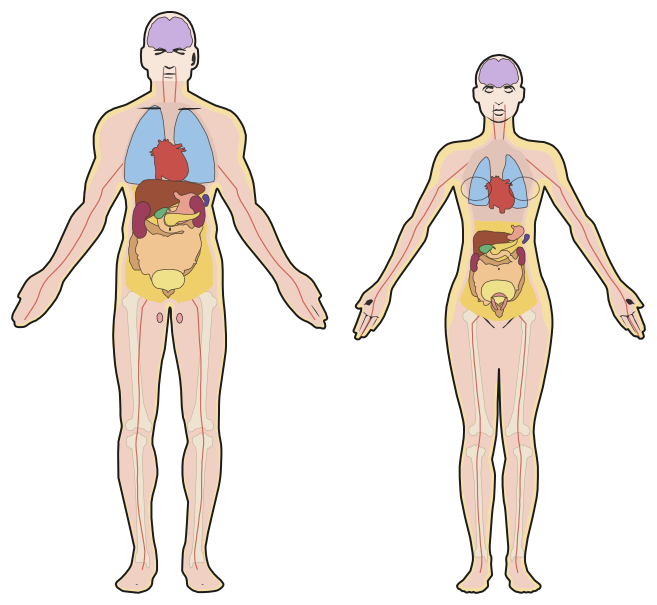
The man and the woman of the reference individuals of the library stand next to each other, each captioned with its build; the builds share the structure of the definition, so one label serves both. The bodies carry:
- the organs in the forms of the drawing, each sized by its volume in the model, the cube root of its volume over the volume of the reference individual; the space between them is visceral adipose tissue (abdomen) or mediastinum (thorax);
- the layers of the body: the subcutaneous adipose tissue as a band under the skin (its thickness from the subcutaneous depot of the library over the body surface, twice on the trunk), the muscle, the bones of the legs and the arteries;
- the connections of the model: the portal vein into the liver, the bile from the liver over the gallbladder into the duodenum, the ureters to the bladder and out, the feces and the oral route;
- circled icons: a tablet for an oral dose, a syringe for an intravenous dose, a drop for the blood sample at the arm vein.
Every organ has a label with its circled icon, in greys (palette.ORGAN_GREYS) so that the colours of a figure are those of the substances and the tissues, and its substances: a filled dot where the substance enters the tissue, a dashed ring where it stays in the plasma. An organ with processes shows its submodel: a row per substance, the compartments plasma, interstitium, cells and the apical side (bile, urine, lumen) as columns, a dot for every species the build has, arrows for the exchange with the plasma, the metabolism with its enzyme, the apical transport with its transporter and the filtration into the urine; the process lines of the schematic follow.
Hovering an organ, a label, a substance or an icon shows its details (the volumes of the organ in the reference man and woman, its UBERON ids, the form of every substance, the processes). It is one HTML file without external scripts, for the docs or GitHub Pages; on github.com itself a README shows the SVG as an image, without scripts, so link the page from there.
The bodies alone
anatomy_figure(definition, path, annotations=False) draws the bodies of the builds with their organs and layers alone, without labels, substances, connections, captions and key, on a transparent background, for a slide or a poster. A definition of a laboratory animal gives the animal alone. The drawings are the anatomograms of the Expression Atlas (CC BY 4.0), so a slide credits them next to the figure, see Anatomy and license.
The schematic
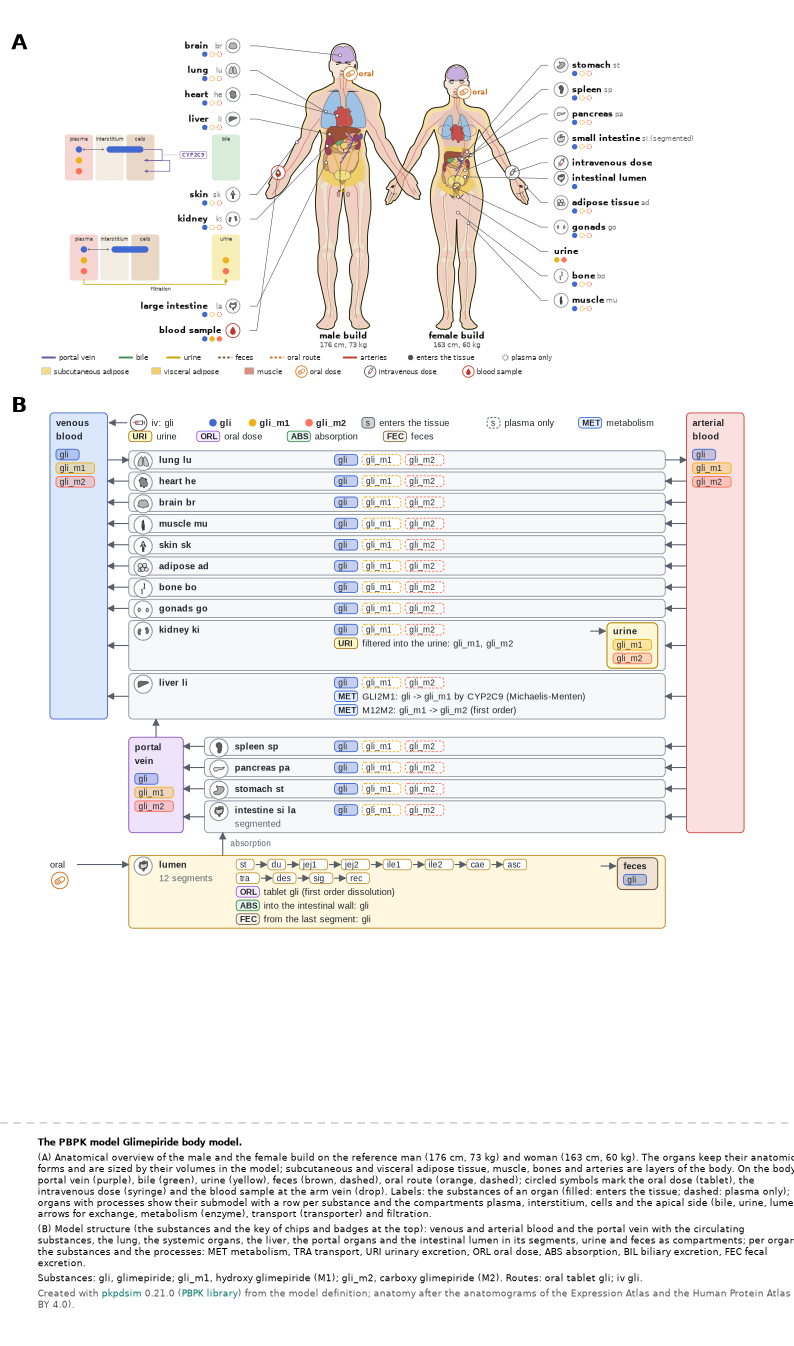
The circulation of the model: venous blood on the left and arterial blood on the right, each listing the substances which circulate, the lung between them, the systemic organs, the liver with the portal vein (with its substances) and the portal organs, the intestinal lumen in its segments, urine and feces as compartments with their substances. Every row carries the grey icon of its organ, its substances (filled: enters the tissue; dashed: plasma only) and its processes as badges: MET metabolism, TRA transport, CUS custom reaction, URI urine, SLW slow pool, ORL oral dose, ABS absorption, BIL bile, CNV lumen conversion, FEC feces. The legend (the substances with their mechanisms, the routes, the PD components and the key) is a column right of the diagram; the process text wraps at a fixed measure (MAX_TEXT) and the width of the figure is that of its content. model_figure(..., compact=True) is the panel of a publication figure: the substances and the key in the band above the first row, tighter rows.
Hovering an organ row, a substance chip or a process line shows its details.
The publication figure
One A4 page with the anatomical figure (A) and the schematic (B), each in compact form at the width of the page; only the panels have to fit on the page, the legend sits below them. publication_figure(definition, path) writes the panels with the legend below (path), the panels alone on the A4 page (<stem>_panels.svg), the legend as Markdown for the caption of a manuscript (<stem>_legend.md) and, with pdf=True, the PDF of the panels (the extra pdf, pip install pkpdsim[pdf], needs the cairo library of the system).
Pictograms of impaired organs
impaired_organ(key, cx, cy, width, height, loss, color, title=None) of pkpdsim.pbpk.visual.icons draws the liver (li), a kidney (ki) or the heart (he) as a pictogram on a card framed in the color of an impairment class: the shape of the anatomy resources in the color of the organ with its details (the lobes and the gallbladder of the liver, the cortex, vessels and ureter of a kidney, the groove of the heart), the lost part loss of its area faded (the liver from the right, the kidney and the heart from the top). The overview of Impairment shows them for every class, the figure of Impairment classes above the scales of the classes.
Individuals
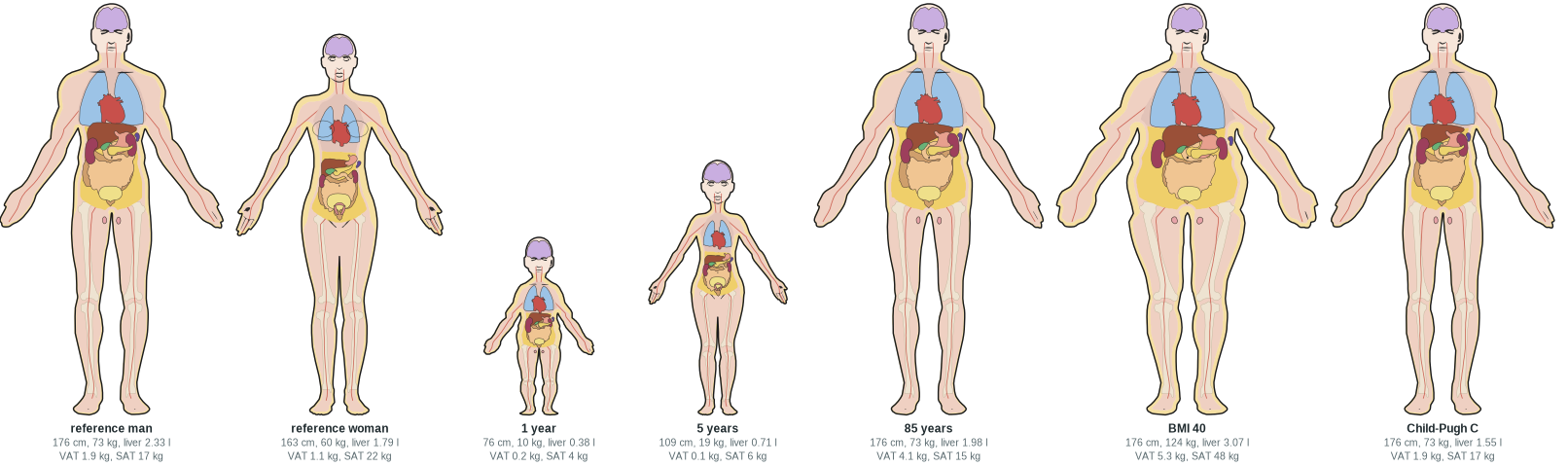
The body of an individual follows its numbers in the library: the height and weight of its age, the waist of the visceral depot, the subcutaneous and visceral adipose tissue and the volumes of its organs. The drawing changes by stretching: the proportions of the age along the height, the trunk by the waist, the limbs and the face by the body mass index, the pregnant belly as the one local change. Individual(sex, age=35.0, bw=None, height=None, liver=1.0, pregnant=0.0, label="") of pkpdsim.pbpk.visual.body is the reference individual of the age by default; liver is the functional liver of a Child-Pugh class.
from pkpdsim.pbpk import Sex, body_strip
from pkpdsim.pbpk.visual.body import Individual

svg = body_strip(
    [
        Individual(Sex.MALE, label="reference man"),
        Individual(Sex.MALE, bw=40 * 1.76**2, label="BMI 40"),
    ]
)
print(svg[:4])
Anatomy and license
The drawings are the anatomograms of the Expression Atlas of EMBL-EBI, which the Human Protein Atlas uses as well, under CC BY 4.0 (https://github.com/ebi-gene-expression-group/anatomogram). scripts/visual/anatomy_assets.py converts them at a pinned commit into one JSON resource per species and sex in pkpdsim/resources/anatomy/ (the human male and female, the mouse male and female and the rat): the outline, the organs of the library by their Organ key with their UBERON ids, further anatomy, the landmarks and the body cavities (pkpdsim.pbpk.visual.resources). A figure names the anatomograms, their license and pkpdsim in its legend, never inside the figure; the interactive pages carry the legend below the figure.