Network model
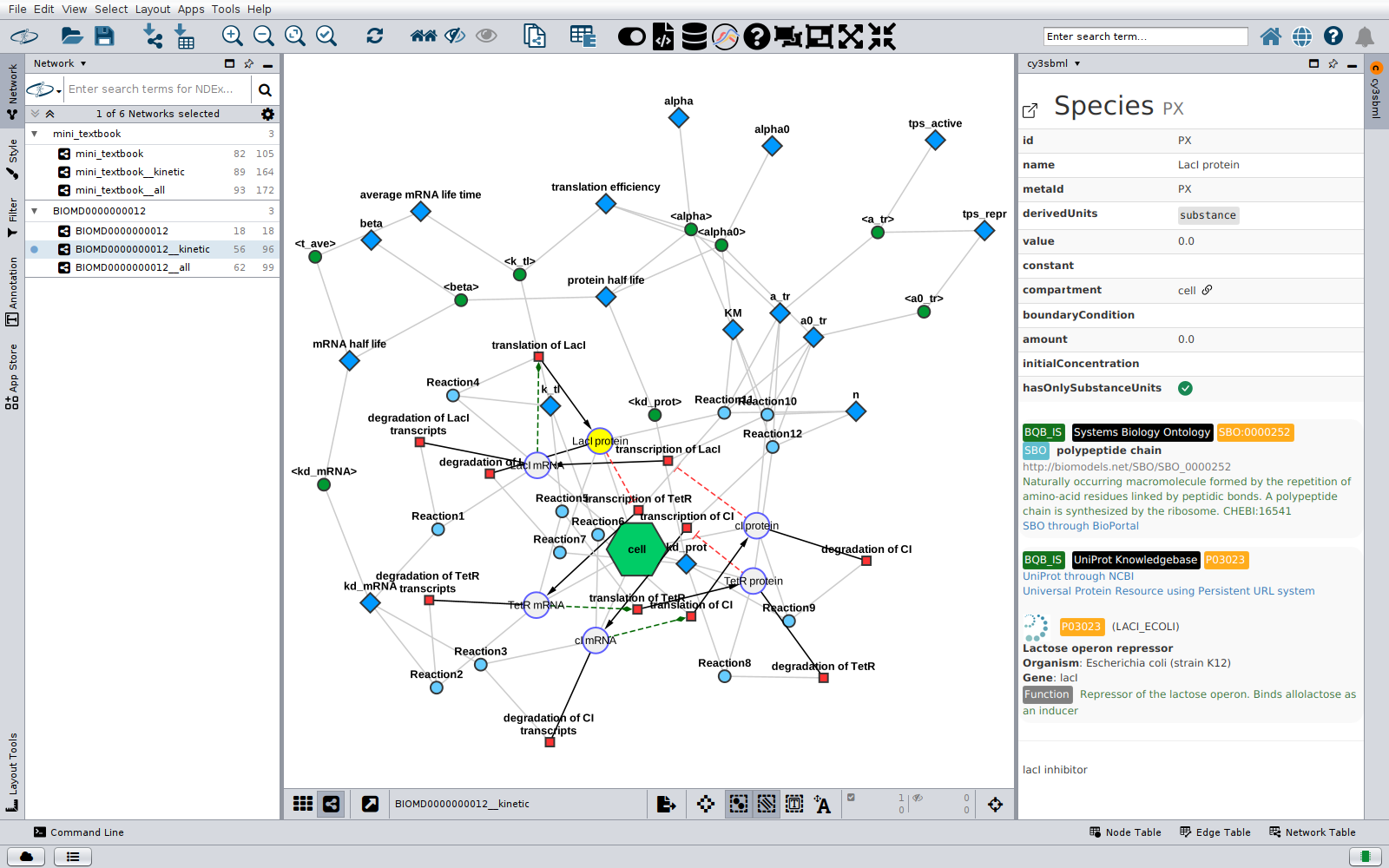
cy3sbml converts every SBML object into a node, and the relations between the objects into edges. This page describes the networks, node types, edge types and table columns that an import creates.
Networks
For every model, the import creates one network collection (root network) <name> with
three networks, and one more network per layout of the model. <name> is the model id, or the
file name if the model has no id. After the import, the base network of the main model is
the current network.
| Network | Content |
|---|---|
<name> |
The base network: species, reactions, qualitative species and transitions, and the fbc gene products and gene associations, with the reactant, product, modifier, transition and association edges. The SBML groups are Cytoscape groups in the base, kinetic and all network, each with its members in the network, see groups. |
<name>__kinetic |
The kinetic network: the base network plus compartments, parameters, rules, initial assignments, kinetic laws, local parameters, function definitions and comp ports, replaced elements, replaced by elements and deletions, with the edges between them, for example to the compartment, from the flux bound parameters and from the objects referenced in the math. |
<name>__all |
All nodes and edges: the kinetic network plus events, constraints, unit definitions and units, and comp submodels. |
<name>__layout_<layout id> |
A layout of the layout package: a node per glyph at the position of the glyph, see Layouts. <layout id> is the number of the layout (1, 2, ...) if it has no id. |
The comp package can define several models in one file, and refer to models in other
files. Every model gets its own network collection: the main model, every model
definition and every external model. The flattened model of a model with submodels gets
the collection Flat__<name>, with the networks Flat__<name>,
Flat__<name>__kinetic and Flat__<name>__all.
Node types
The type of a node is in the column sbml type.
sbml type |
SBML object | Networks |
|---|---|---|
species |
Species | base, kinetic, all |
reaction |
Reaction | base, kinetic, all |
compartment |
Compartment | kinetic, all |
parameter |
Parameter | kinetic, all |
kineticLaw |
KineticLaw | kinetic, all |
localParameter |
LocalParameter | kinetic, all |
rateRule, assignmentRule, algebraicRule |
Rules | kinetic, all |
initialAssignment |
InitialAssignment | kinetic, all |
functionDefinition |
FunctionDefinition | kinetic, all |
event, eventAssignment |
Event, EventAssignment | all |
constraint |
Constraint | all |
unitDefinition, unit |
UnitDefinition, Unit | all |
qual_species |
QualitativeSpecies (qual) | base, kinetic, all |
qual_transition |
Transition (qual) | base, kinetic, all |
fbc_geneProduct |
GeneProduct (fbc) | base, kinetic, all |
fbc_and, fbc_or |
And, Or of a gene product association (fbc) | base, kinetic, all |
fbc_userDefinedConstraint |
UserDefinedConstraint (fbc version 3) | kinetic, all |
comp_submodel |
Submodel (comp) | all |
comp_port |
Port (comp) | kinetic, all |
comp_replacedElement, comp_replacedBy |
ReplacedElement, ReplacedBy (comp) | kinetic, all |
comp_deletion |
Deletion (comp) | kinetic, all |
group |
Group (groups) | as Cytoscape group in base, kinetic and all |
layout:speciesGlyph, layout:reactionGlyph, layout:compartmentGlyph, layout:generalGlyph, layout:graphicalObject |
glyph whose element is not in the model (layout) | layout |
In a layout network, the node of a glyph of an element has the columns of the node of the
element, including sbml type.
The column sbml type ext refines the type for the visual style: reactions are
reaction reversible or reaction irreversible.
Edge types
The type of an edge is in the column interaction type. All edges are directed.
interaction type |
From | To |
|---|---|---|
reaction-reactant |
reaction | reactant species |
reaction-product |
reaction | product species |
reaction-modifier |
reaction | modifier species |
species_compartment |
species or qualitative species | compartment |
reaction_compartment |
reaction | compartment |
reaction_kineticLaw |
reaction | kinetic law |
localParameter_kineticLaw |
local parameter | kinetic law |
reference_kineticLaw |
object referenced in the math | kinetic law |
variable_rule, reference_rule |
rule variable, object referenced in the math | rule |
variable_initialAssignment, reference_initialAssignment |
assigned variable, object referenced in the math | initial assignment |
trigger_event, priority_event, delay_event |
object referenced in the trigger, priority or delay | event |
variable_eventAssignment, reference_eventAssignment |
assigned variable, event or object referenced in the math | event assignment |
unit_unitDefinition |
unit | unit definition |
sbase_unitDefinition |
object with units | unit definition |
parameter_reaction |
flux bound parameter (fbc) | reaction |
input_transition |
transition | input qualitative species |
transition_output |
transition | output qualitative species |
species_geneProduct |
associated species | gene product (fbc) |
association_reaction |
gene product or top and/or node of the association | reaction (fbc) |
association_association |
gene product or and/or node | the and/or node it belongs to (fbc) |
parameter_userDefinedConstraint |
bound or coefficient parameter | user defined constraint (fbc) |
variable_userDefinedConstraint |
reaction or parameter of a component variable | user defined constraint (fbc) |
sbaseRef-id, sbaseRef-metaId, sbaseRef-unit, sbaseRef-port |
comp port, deletion, replacedElement or replacedBy node | referenced element in the same model |
sbaseRef-submodel |
comp replacedElement or replacedBy node | its submodel |
sbase-deletion |
comp submodel, or replacedElement of a deletion | deletion |
sbase-replacedElement, sbase-replacedBy |
element with the replacement | its replacedElement or replacedBy node |
layout:reference |
general glyph (layout) | glyph of one of its reference glyphs |
In a layout network, the edges between a reaction and its species are copies of the edges of
the model with their type and columns. An edge of a species reference glyph without edge in
the model gets the type of its role, for example reaction-product or reaction-inhibitor.
See Layouts.
The column shared interaction refines the type for the visual style: a modifier edge
whose SBO term is an inhibitor term (for example SBO:0000020) is reaction-inhibitor,
one with an activator or catalyst term (for example SBO:0000459 or SBO:0000013) is
reaction-activator.
Table columns
These columns are set on nodes, when the SBML object has the value:
| Column | Content |
|---|---|
sbml id |
SBML id; the ids of unit definitions are in the column unitSid and the ids of ports in portSid, because they have their own namespaces |
shared name, name |
SBML name |
label |
name, or id if the object has no name (the kind for units, the label for fbc gene products); the node label of the style |
metaId |
SBML metaid |
sbo |
SBO term, for example SBO:0000247 |
cyId |
unique id that maps the node to its SBML object |
sbml compartment |
compartment of a species or reaction |
compartmentCode |
number of the compartment (1, 2, ...), used for the border color |
sbml initial concentration, sbml initial amount, sbml charge |
species values |
boundaryCondition, hasOnlySubstanceUnits, conversionFactor, substanceUnits |
species attributes |
constant, value, units, derivedUnits |
attributes of quantities |
size, spatialDimensions |
compartment attributes |
reversible, fast, kineticLaw |
reaction attributes; kineticLaw holds the formula |
math |
formula of rules, initial and event assignments, kinetic laws, constraints and function definitions, with the inline units of numbers after the number (1 dimensionless) |
variable |
variable of a rule or assignment |
initialAssignment |
on the variable of an initial assignment: the formula of the assignment |
message |
message of a constraint |
useValuesFromTriggerTime |
event attribute |
stoichiometry |
stoichiometry, on reactant and product edges (1 if not set) |
sbml id, shared name, metaId, sbo |
on reactant, product and modifier edges: the attributes of the species reference |
kind, exponent, scale, multiplier |
unit attributes |
cofactorClone |
true for the clones of a split node, see Cofactor nodes |
Package columns:
qual:qual_initialLevel,qual_maxLevel,qual_sign,qual_tresholdLevel,qual_transitionEffect,qual_qualitativeSpecies,qual_outputLevel,qual_resultLevels.fbc:fbc_strict(network table),fbc_chargeandfbc_chemicalFormula(species),fbc_lowerFluxBoundandfbc_upperFluxBound(reactions), one columnfbc_objective-<objective id>per objective with the objective coefficient of the reactions and, for fbc version 3,fbc_objective-<objective id>_variableTypewith the variable type;fbc_lowerBoundandfbc_upperBound(user defined constraints),fbc_coefficientandfbc_variableType(edges of the constraint components).comp:comp_portRef,comp_idRef,comp_unitRef,comp_metaIdRef,comp_sBaseRef,comp_submodelRef,comp_conversionFactor,comp_deletion,comp_modelRef,comp_timeConversionFactor,comp_extentConversionFactor, and the resolved targetcomp_targetModel,comp_targetId,comp_targetType,comp_targetMetaIdwithcomp_resolution.distrib:distrib_uncertaintyanddistrib_uncertaintyCounton the node of every element with uncertainties, and on the edges of species references. See distrib.
Annotations become columns too. Every resource of an RDF annotation is stored in a column
named after its identifiers.org collection, with the identifier as value. For models with
the fbc package, the KEY: value paragraphs in the notes of species, reactions and gene
products (the COBRA notes format, for example GENE_ASSOCIATION) are stored as columns
named KEY.
The model is stored in the network table, in the row of the __all network: the columns
sbmlNetwork (sbml), sbmlVersion (for example L3 V1), the id, name, metaid, SBO term
and annotations of the model, and the model attributes substanceUnits, timeUnits,
volumeUnits, areaUnits, lengthUnits, extentUnits and conversionFactor. The base and
the kinetic network have only their name. The layout networks have sbmlNetwork
sbmlLayout. Every network has the column sbmlSubnetwork with its kind: base,
kinetic, all or layout. Unlike the name, it does not change when Cytoscape renames a
network of a model imported twice; the automation commands return it as
the network type. The root network of a model imported
from a COMBINE archive has the column archive with the name of the archive.
The layout networks have their own columns (not in the other networks):
| Column | Content |
|---|---|
layout_id |
id of the layout (network table) |
layout_glyph |
id of the glyph of the node (the metaid for a glyph without id), empty for the nodes of reactions without glyph |
layout_glyphType |
layout:compartmentGlyph, layout:speciesGlyph, layout:reactionGlyph, layout:generalGlyph, layout:graphicalObject, or layout:generated for a reaction or transition without glyph |
layout_x, layout_y |
centre of the bounding box of the glyph |
layout_width, layout_height |
size of the bounding box of the glyph |
layout_role |
role of the reference glyph of a layout:reference edge |
Mapping to the SBML document
cy3sbml keeps the SBML document of every imported network, and maps every node to its
SBML object with the cyId column. The info panel uses this mapping.
Networks created from an SBML network with Cytoscape functions, for example
File → New Network → From Selected Nodes, All Edges, keep the mapping, because they
belong to the same network collection.
The documents and mappings are saved in Cytoscape session files (.cys) and restored
when the session is opened.