Data formats
Pharmacokinetic data is exchanged as tables, not as Timecourse objects, and the field uses a handful of table layouts: the event record of NONMEM and Monolix, the two tables of PKNCA, and the CDISC ADaM ADNCA dataset. pkpdutils.io reads every one of them into a Timecourses batch and writes every one of them back, so a study read from any of the three formats runs through the same non-compartmental analysis and is handed on in the format the next step asks for. pkpdutils.cdisc writes the parameters of the analysis as the CDISC PP domain, and pkpdutils.crosswalk writes and reads them in the result tables of Phoenix WinNonlin, PKNCA and NonCompart ("The result tables of other tools" below).
Concepts
Three layouts, three readers, one batch:
flowchart LR
  EV["NONMEM / Monolix<br/>event records<br/>ID, TIME, DV, AMT, EVID, MDV"] --> RE["read_events<br/>ADDL/II expansion<br/>SS history<br/>RATE/TINF duration"]
  PK["PKNCA<br/>concentration table<br/>+ dose table"] --> RP["read_pknca<br/>joined on the subject"]
  AD["CDISC ADaM ADNCA<br/>USUBJID, AVAL, AFRLT, ARRLT"] --> RA["read_adnca<br/>dose times = AFRLT - ARRLT<br/>DTYPE == COPY dropped"]
  RE --> BB["one sample dimension, one route,<br/>a Dosing per subject,<br/>constant columns -> coordinates"]
  RP --> BB
  RA --> BB
  BB --> T["Timecourses"]
  T -->|"write_events"| EV
  T -->|"write_pknca"| PK
  T -->|"write_adnca"| AD
  T --> N["nca"]
  N --> PP["NCAResult<br/>to_pp / write_pp<br/>PP domain"]
Event records. NONMEM and Monolix exchange data as one row per event of one subject: a row is a dose or an observation, and the columns describe what happened at that time - AMT/DV the amount or the value, EVID/MDV which kind of row it is. Repeated dosing does not need one row per dose: ADDL/II expand one dose record into several at a fixed interval, and SS marks a dose as already at steady state, standing for a dosing history rather than a single administration. With an EVID column the two rules are read independently, so a row may be a dose (EVID 1) and carry an observed value; without one a row with AMT > 0 is a dose and nothing else, as NM-TRAN reads such a table, and a DV on it is ignored with a warning. A table which records a dose and a sample in one row therefore needs an EVID column.
The two table layout. PKNCA keeps the concentrations and the doses in separate tables, joined by the subject (and, for a multi-analyte or multi-period study, further grouping columns). This is closer to how data usually arrives from a bioanalytical lab and a dosing log than the single event table, and pkpdutils.io.read_pknca reads both without merging them first.
The ADaM layout. The CDISC ADaM ADNCA (ADPC) dataset is one row per concentration record of one analyte, already reshaped for a non-compartmental analysis: the time is given twice, once since the first dose of the subject (AFRLT) and once since the reference (most recent) dose (ARRLT), so the dose times of a subject are recovered as the distinct values of AFRLT - ARRLT. A predose sample can appear twice, once for the current interval and once, duplicated, for the previous one (DTYPE == "COPY"); pkpdutils drops the duplicate.
The column keywords. Every column name a reader takes is a keyword ending in _col (id_col, time_col, dv_col, amt_col, subject_col, conc_col, dose_col, ...), the default being the name the format uses; the columns kept as coordinates are named by covariates on all three readers.
What every reader does. A reader returns a Timecourses batch with one sample dimension (individual by default), the observation times exactly as given (readers never shift the time axis to the dose), one route for the whole batch, and the dosing protocol of every subject as a Dosing. analytes adds a second sample dimension, one entry per analyte of the study. A subject which is not a curve is an error naming the subject, a ValueError and never a pydantic dump: fewer than two observations, a time which is not a number, duplicate sampling times, or dose records which are not a protocol (an infusion without a duration, a dose time which is not a number). Columns are looked up case-insensitively, so TIME and time are the same column; a column that is not in the table is treated as absent rather than as an error, except the columns a reader cannot do without. Extra columns which are constant within every subject - a covariate such as body weight, sex, or a dose group - become coordinates along the sample dimension and travel with every later result.
NONMEM / Monolix event records
read_events/Timecourses.from_events and the inverse write_events/to_events, the one row per event format1.
| column | role | notes |
|---|---|---|
ID |
subject | a reader reads one route: a table of several routes is read into one batch per route, which Timecourses.from_timecourses combines into one multi-route batch |
TIME |
time of the row | in time_unit |
DV (Monolix OBSERVATION) |
observed value | in unit; a dose row leaves it empty |
AMT (Monolix AMOUNT) |
dose amount | in dose_unit; 0 or empty for an observation |
EVID |
event kind | 1 dose, 0 observation, 2/3 dropped (logged), 4 (reset and dose) raises: the reader would merge the periods it separates into one protocol; without this column AMT > 0 is a dose only and a value in DV on such a row is ignored (logged) |
MDV |
missing dependent value | 1 marks the value of the row as missing even with a value in DV; the row keeps its sampling time and is read as NaN (keep_missing=False drops it instead) |
SD/SE/N |
uncertainty of a group curve | written by write_events when the batch carries them and read back into sd, se and n; N is constant within a subject |
RATE |
infusion rate | duration = AMT / RATE for RATE > 0; RATE -1/-2 (a modelled rate) is not data and raises |
TINF (Monolix INFUSION DURATION) |
infusion duration | wins over RATE when positive |
ADDL (Monolix ADDITIONAL DOSES) |
additional doses | expands into ADDL further doses at II |
II (Monolix INTERDOSE INTERVAL) |
interdose interval | required with a positive ADDL or SS == 1 |
SS (Monolix STEADY STATE) |
steady state dose | 1 stands for ss_doses (default 5) preceding doses at II and sets attrs["steady_state_marker"] on the batch; 0 is a plain dose, any other value raises |
CMT/ADM |
compartment | not interpreted, not a route |
import io

import pandas as pd

from pkpdutils import Route, Timecourses

# a small event table: two subjects, one dose record each which stands for two
# doses twelve hours apart (ADDL/II), and the body weight as a covariate
table = """ID,TIME,DV,AMT,EVID,MDV,ADDL,II,WT
1,0,.,100,1,1,1,12,70
1,1,5.1,.,0,0,.,.,70
1,4,3.9,.,0,0,.,.,70
1,12,1.2,.,0,0,.,.,70
1,13,5.4,.,0,0,.,.,70
1,24,1.4,.,0,0,.,.,70
2,0,.,100,1,1,1,12,85
2,1,4.4,.,0,0,.,.,85
2,4,3.4,.,0,0,.,.,85
2,12,1.0,.,0,0,.,.,85
2,13,4.7,.,0,0,.,.,85
2,24,1.1,.,0,0,.,.,85
"""
events = pd.read_csv(io.StringIO(table))  # a file: pd.read_csv("study_events.csv")
batch = Timecourses.from_events(
    events,
    time_unit="hr",
    unit="ng/ml",
    dose_unit="mg",
    route=Route.ORAL,
    substance="drug",
    covariates=["WT"],
)
print(batch.sample_dims, batch.sample_shape, batch.ds["WT"].values)
print(batch.dosing_of(individual=1))
print(batch.to_events().head(4).to_string(index=False))  # the inverse
('individual',) (2,) [70 85]
amounts=array([100., 100.]) times=array([ 0., 12.]) durations=None unit='mg' route=<Route.ORAL: 'oral'>
 ID  TIME  DV   AMT  EVID  MDV  RATE  WT
  1   0.0 NaN 100.0     1    1   0.0  70
  1   1.0 5.1   0.0     0    0   0.0  70
  1   4.0 3.9   0.0     0    0   0.0  70
  1  12.0 NaN 100.0     1    1   0.0  70
The one dose record of the table became a protocol of two doses, the weight became a coordinate of the batch, and to_events writes the expanded protocol back as one row per dose. The batch is the input of nca, which analyses both dosing intervals, see Non-compartmental analysis.
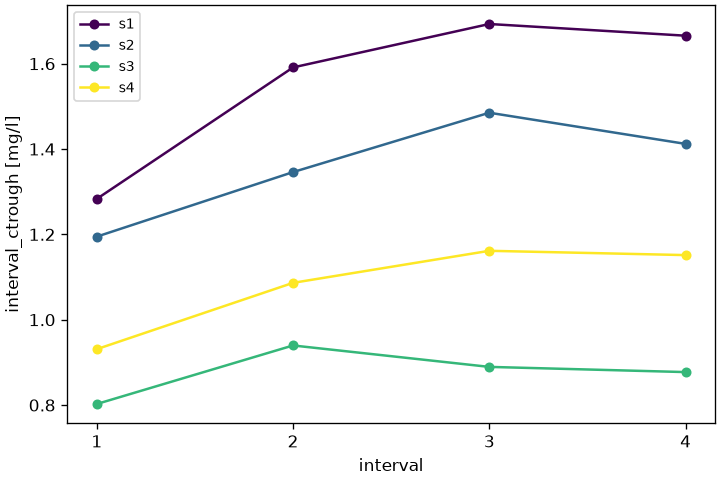
examples/formats.py writes a twice daily batch as event records, reads it back and analyses every dosing interval of the round trip:
PKNCA tables
read_pknca/Timecourses.from_pknca: the concentration table and the dose table of the R package PKNCA2, joined on the subject.
| keyword | default column | table | role | notes |
|---|---|---|---|---|
subject_col |
subject |
both | subject | joins the two tables |
time_col |
time |
concentrations | observation time | in time_unit |
conc_col |
conc |
concentrations | observed value | 0 codes below the limit of quantification, NA codes missing, both kept as given |
dose_time_col |
time |
doses | dose time | in time_unit, 0 when the column is absent |
dose_col |
dose |
doses | dose amount | in dose_unit |
duration_col |
duration |
doses | infusion duration | optional, absent allowed, None reads none; write_pknca writes it under this name, so an infusion batch round trips |
covariates |
none | either | covariate columns | constant per subject, become coordinates along the sample dimension |
import io

import pandas as pd

from pkpdutils import Route, Timecourses

conc = pd.read_csv(
    io.StringIO(
        """subject,treatment,time,conc
1,A,0,0
1,A,1,4.2
1,A,4,3.0
1,A,12,1.0
2,B,0,0
2,B,1,4.0
2,B,13,5.5
2,B,24,2.0
"""
    )
)
doses = pd.read_csv(
    io.StringIO(
        """subject,treatment,time,dose
1,A,0,100
2,B,0,100
2,B,12,100
"""
    )
)
batch = Timecourses.from_pknca(
    conc,
    doses,
    time_unit="hr",
    unit="ng/ml",
    dose_unit="mg",
    route=Route.ORAL,
    covariates=["treatment"],
)
print(batch.ds["treatment"].values, batch.n_doses)  # ['A' 'B'] [1 2]
The two tables are the fixtures tests/data/formats/pknca_conc.csv and pknca_dose.csv of the repository, row for row; the second subject has two dose records and therefore a protocol of two doses, the first one a single dose.
CDISC ADaM ADNCA
read_adnca/Timecourses.from_adnca: the analysis dataset of a non-compartmental analysis3.
| keyword | default column | role | notes |
|---|---|---|---|
subject_col |
USUBJID |
subject | |
param_col |
PARAMCD |
analyte code | rows are filtered to analyte, the single analyte of the dataset by default |
value_col, value_unit_col |
AVAL, AVALU |
value, its unit | unit given by the caller wins over AVALU |
time_first_col |
AFRLT |
time since the first dose | the observation time |
time_ref_col |
ARRLT |
time since the reference dose | AFRLT - ARRLT gives the dose times of a subject, one per distinct value |
dose_col, dose_unit_col |
DOSEA, DOSEU |
dose amount, its unit | the amount of the dose at the recovered time; disagreeing amounts at the same dose time raise |
route_col |
ROUTE |
route | ORAL/PO, IV/INTRAVENOUS/IV BOLUS, IV INFUSION; the caller's route= wins |
duration_col |
ADUR |
infusion duration | optional, absent in most datasets, None reads none; without it an infusion protocol cannot be read and Route.IV_INFUSION raises, and such a study is read from the event records or the PKNCA tables instead |
nominal_time_col |
NRRLT |
nominal time | optional, None reads none; it becomes the variable nominal_time over (individual, time) in the frame of the column itself (NRRLT within the dosing interval, NFRLT since the first dose, which is the frame of the observation times the reader writes) |
dtype_col |
DTYPE |
derivation type | COPY rows (the predose record duplicated into the previous interval) are dropped |
lloq_col |
ALLOQ |
lower limit of quantification | kept as the coordinate lloq along the sample dimension; the analysis reads it per subject when NCAOptions.lloq names no limit of its own, see NCA |
covariates |
none | covariate columns | constant per subject, become coordinates along the sample dimension |
import io

import pandas as pd

from pkpdutils import Timecourses

# one row per concentration record; the pre-dose sample of the second interval
# is duplicated into the first one (DTYPE == COPY) and is dropped
adnca = pd.read_csv(
    io.StringIO(
        """USUBJID,PARAMCD,AVAL,AVALU,AFRLT,ARRLT,DOSEA,DOSEU,ROUTE,DTYPE,ALLOQ
S1,XAN,0.05,ng/mL,0.5,0.5,100,mg,ORAL,,0.1
S1,XAN,4.2,ng/mL,1,1,100,mg,ORAL,,0.1
S1,XAN,1.0,ng/mL,12,12,100,mg,ORAL,,0.1
S2,XAN,4.0,ng/mL,1,1,100,mg,ORAL,,0.1
S2,XAN,1.1,ng/mL,12,12,100,mg,ORAL,,0.1
S2,XAN,1.1,ng/mL,12,0,100,mg,ORAL,COPY,0.1
S2,XAN,5.5,ng/mL,13,1,100,mg,ORAL,,0.1
S2,XAN,2.0,ng/mL,24,12,100,mg,ORAL,,0.1
"""
    )
)
batch = Timecourses.from_adnca(adnca, analyte="XAN")
for label in batch.ds["individual"].to_numpy():
    print(label, batch.dosing_of(individual=str(label)).times)
The dose times were recovered from AFRLT - ARRLT: the first subject was dosed once, the second one twice. The same extract is the fixture tests/data/formats/adnca.csv of the repository and examples/formats.py reads it.
Analytes
A study measures more than one analyte: a parent drug and its metabolite, two enantiomers, a drug and its interaction marker. Every reader takes analytes, the values of its analyte column to read (PARAMCD of an ADNCA dataset, the analyte column of a PKNCA concentration table, a column of an event table named with analyte_col); it reads every one of them on its own and stacks the batches along the sample dimension analyte, whose coordinate substance names the analyte of every row. In an event table a row which names no analyte, a dose record, belongs to every one of them.
The batch is then analysed in one call: the analysis follows the substance of every sample, the result carries the coordinate, and metabolite_ratio divides the exposure of the metabolite by the exposure of the parent, subject by subject. With the molar masses the ratio is on a molar basis, (AUC_m / M_m) / (AUC_p / M_p), which is what a ratio of two substances measured in mass concentrations means.
import io

import pandas as pd

from pkpdutils import Timecourses, nca
from pkpdutils.nca import metabolite_ratio

adnca = pd.read_csv(
    io.StringIO(
        """USUBJID,PARAMCD,AVAL,AVALU,AFRLT,ARRLT,DOSEA,DOSEU,ROUTE
S1,PARENT,4.2,ng/mL,1,1,100,mg,ORAL
S1,PARENT,3.0,ng/mL,4,4,100,mg,ORAL
S1,PARENT,1.0,ng/mL,12,12,100,mg,ORAL
S1,META,2.1,ng/mL,1,1,100,mg,ORAL
S1,META,1.5,ng/mL,4,4,100,mg,ORAL
S1,META,0.5,ng/mL,12,12,100,mg,ORAL
S2,PARENT,4.0,ng/mL,1,1,100,mg,ORAL
S2,PARENT,2.8,ng/mL,4,4,100,mg,ORAL
S2,PARENT,0.9,ng/mL,12,12,100,mg,ORAL
S2,META,2.0,ng/mL,1,1,100,mg,ORAL
S2,META,1.4,ng/mL,4,4,100,mg,ORAL
S2,META,0.45,ng/mL,12,12,100,mg,ORAL
"""
    )
)
batch = Timecourses.from_adnca(adnca, analytes=["PARENT", "META"])
print(batch.sample_dims, batch.substances[:, 0])
result = nca(batch)
print(metabolite_ratio(result, parent="PARENT", metabolite="META", parameters=["cmax"]))
Timecourses.substance returns the substance of a batch which has one and raises for a batch of several, which names them in Timecourses.substances; the same holds for Timecourses.route and Timecourses.routes of a batch which mixes an intravenous reference with an oral test, see Non-compartmental analysis.
Writing PKNCA and ADNCA
write_pknca/Timecourses.to_pknca writes the two tables of PKNCA and write_adnca/Timecourses.to_adnca an ADNCA dataset, so that all three formats round trip. Both take the file to write (None writes no file and returns the frame only) and the same *_col keywords as their readers.
The concentration table holds one row per sample and observation and the dose table one row per dose of every protocol; an ADNCA dataset holds one row per observation with AFRLT the time of the record, ARRLT its time since the reference dose (the last dose at or before it) and DOSEA the amount of that dose, which is how the reader recovers the protocol. The coordinates along the sample dimension become further columns, which the reader reads back as covariates, and a batch of several analytes writes the analyte of every row.
from pkpdutils import Route

conc, doses = batch.to_pknca()
print(conc.head(2).to_string(index=False))
print(doses.head(2).to_string(index=False))
back = Timecourses.from_pknca(
    conc,
    doses,
    time_unit="hr",
    unit="ng/mL",
    dose_unit="mg",
    route=Route.ORAL,
    analyte_col="analyte",
    analytes=["PARENT", "META"],
)
print(back.sample_dims, float(back.values[1, 0, 0]))
subject analyte  time  conc
     S1  PARENT   1.0   4.2
     S1  PARENT   4.0   3.0
subject analyte  time  dose
     S1  PARENT   0.0 100.0
     S2  PARENT   0.0 100.0
('analyte', 'individual') 2.1
A dose which is not followed by an observation is not the reference dose of any record and is therefore not in an ADNCA dataset, which is a property of the format rather than of the writer: the protocol of a subject lives in its concentration records.
The PP domain
A submission reports the parameters in the PP domain of SDTM (or the ADPP dataset of ADaM derived from it), where every parameter is named by a code of the CDISC controlled terminology rather than by the name of an analysis package. pkpdutils.cdisc holds the crosswalk: PKPARMCD maps every variable of a result to its code, pkunit writes a unit as PKUNIT spells it and to_pp/write_pp lay a result out as the domain, one row per subject and parameter.
The codes are read from src/pkpdutils/data/pkparmcd.csv, extracted from the NCI EVS package of the SDTM terminology (codelist C85839), whose version and checksum the header of the file names. A variable the terminology has no code for is left out with a warning: clast_pred has none (there is no CLSTP), and the steady state peak and trough are CMAX and CMIN with PPSCAT = "STEADY STATE", since no CMAXSS and no CMINSS exist. PPSCAT comes from the analysis of the sample: every parameter of a subject which was analysed over its dosing intervals is STEADY STATE, because its peak, its exposure and its clearance are computed from the last dose on. A unit the terminology does not spell is written in the CDISC symbols and named in a warning. The variables CDISC defines as a percentage while the package reports a fraction (auc_extrap_fraction, fluctuation) are written multiplied by 100 with the unit %, and PPRFTDTC is empty: the analysis works on elapsed times and never sees a date.
from pkpdutils.cdisc import to_pp

pp = to_pp(result, subject_dim="individual", studyid="STUDY-1")
columns = ["USUBJID", "PPTESTCD", "PPTEST", "PPCAT", "PPSCAT", "PPORRES", "PPORRESU"]
print(pp.loc[pp["PPTESTCD"].isin(["CMAX", "AUCLST"]), columns].to_string(index=False))
USUBJID PPTESTCD                   PPTEST  PPCAT      PPSCAT PPORRES PPORRESU
     S1     CMAX                     Cmax PARENT SINGLE DOSE     4.2    ng/mL
     S1   AUCLST AUC to Last Nonzero Conc PARENT SINGLE DOSE 27.3631  h*ng/mL
     S2     CMAX                     Cmax PARENT SINGLE DOSE       4    ng/mL
     S2   AUCLST AUC to Last Nonzero Conc PARENT SINGLE DOSE 25.4855  h*ng/mL
     S1     CMAX                     Cmax   META SINGLE DOSE     2.1    ng/mL
     S1   AUCLST AUC to Last Nonzero Conc   META SINGLE DOSE 13.6815  h*ng/mL
     S2     CMAX                     Cmax   META SINGLE DOSE       2    ng/mL
     S2   AUCLST AUC to Last Nonzero Conc   META SINGLE DOSE 12.7428  h*ng/mL
spec="ADaM" adds the analysis variables PARAMCD, PARAM, AVAL and AVALU of an ADPP dataset and leaves DOMAIN out, usubjid maps the labels of the batch to the identifiers of the study, and write_pp(result, path, ...) writes the csv. The reporting units of the domain come from the result, so a sponsor asking for mL/min gets them by converting the result first, see Units.
The result tables of other tools
A result compared against, or handed on to, another tool is wanted in the table that tool writes. pkpdutils.crosswalk holds the names of every parameter in Phoenix WinNonlin, PKNCA and NonCompart and writes a result in their layouts: to_winnonlin the "Final Parameters Pivoted" table of Phoenix (one row per subject, AUCINF_obs, Cl_F_obs, the extrapolated fractions in percent), to_pknca_results the long table of as.data.frame(pk.nca(...)) (one row per subject and parameter, PPTESTCD and PPORRES) and to_noncompart the table of NonCompart::tblNCA, whose columns are the CDISC codes. The write_* functions write the same tables as csv files, and the read_* functions read a table of the tool back into the variables of pkpdutils, with the percentages as fractions, so that a published result compares against NCAResult.to_dataframe column by column:
from pkpdutils.crosswalk import read_winnonlin, to_pknca_results, to_winnonlin

phoenix = to_winnonlin(result)
long = to_pknca_results(result)
back = read_winnonlin(phoenix)
Benchmark datasets uses them to compare pkpdutils against the published output of Phoenix WinNonlin and against PKNCA and NonCompart, parameter by parameter.
What is not read
An lloq coordinate read from a table travels with the batch and is read by the analysis when the options name no limit, but write_events writes it back only as an ordinary covariate column. The variable nominal_time is written back by write_adnca only: write_events writes the observed times alone, and Timecourses.mean drops it with every other variable it does not reduce, so the nominal times of a group curve are given to the figure rather than read off the batch.
Compartment columns (CMT, ADM) are not interpreted: a study with several compartments is filtered by the caller before reading. A record which resets the subject and doses (EVID 4) and a steady state code other than SS 0/SS 1 describe a dosing history the protocol of a subject cannot hold, and raise rather than being read as an ordinary dose; the caller splits the periods into separate tables. Modelled rates (RATE -1, RATE -2) are not data and raise: the infusion duration is given directly (TINF, duration_col, ADUR) or as a positive rate. A reader reads one route: a table of several routes is read into one batch per route, which are then combined into a multi-route batch with Timecourses.from_timecourses. Reading SAS/XPT files directly is out of scope as well, the caller uses pandas/pyreadstat and passes the resulting DataFrame.
References
The example is examples/formats.py, the reference of the module is in API: io.
-
Bauer RJ. NONMEM Tutorial Part I: Description of Commands and Options, with Simple Examples of Population Analysis. CPT: Pharmacometrics & Systems Pharmacology. 2019;8(8):525-537. See References. ↩
-
Denney W, Duvvuri S, Buckeridge C. Simple, automatic noncompartmental analysis: the PKNCA R package. Journal of Pharmacokinetics and Pharmacodynamics. 2015;42:S65. See References. ↩
-
CDISC. ADaM Implementation Guide for Non-compartmental Analysis Input Data (ADNCA). 2021. See References. ↩